|
| Adenostoma fasciculatum |
| Family: Rosaceae (Rose) |
Flowers:
| color | white |
| style | five petals |
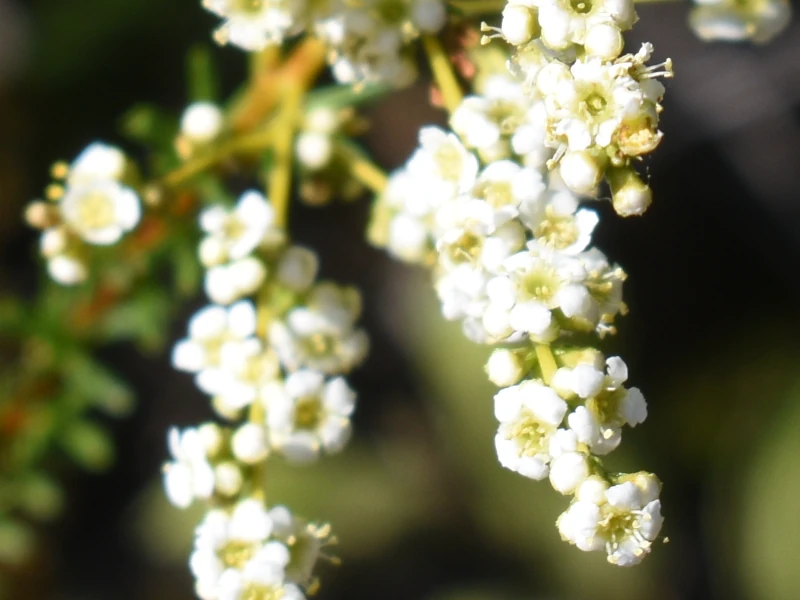
When Chamise blooms, a snowstorm hits the chaparral. Each flower is 1/8" or less and has five round white petals. Fifteen white stamen hold yellow anthers and the pistil seems yellowish. The flowers form in a panicle — branching stem with flowers opening from the bottom up — on new growth. The cluster ranges from two to six inches long and has a conical outline.



Habit:
The perennial shrub Chamise is the predominant plant of the maritime chaparral. It is the most widely distributed plant in California's chaparral, and marine moisture allows manzanita and ceanothus to join it here in BMER. Chamise grows to six feet tall in our area, but it can reach twice that height.
The needle-like leaves are dark green, shiny, hard, and about 1/4" long. They grow in bunches on reddish brown stems that are slightly woody [the similar chaparral plant, mock heather, has flexible green stems]. Chamise branches become gray with age and the bark will coarsen.
Fire plays an important role for Chamise. It may trunk-sprout from its burl after fire, recovering faster than ceanothus or manzanita. Fire also encourages dormant seeds to germinate. The survival rate for seedlings is very low unless there is a gap in the canopy [open sky]. There is a downside. Their resinous needles preserve moisture, but become highly flammable [its nickname is greasewood]. Volatile oils in branches may stop the deer, but also increase the intensity of fire. Sunny.