| Santa Barbara Ceanothus |
| Ceanothus impressus |
| Family: Rhamnaceae (Buckthorn) |
Flowers:
| color | blue |
| style | 5 petals |
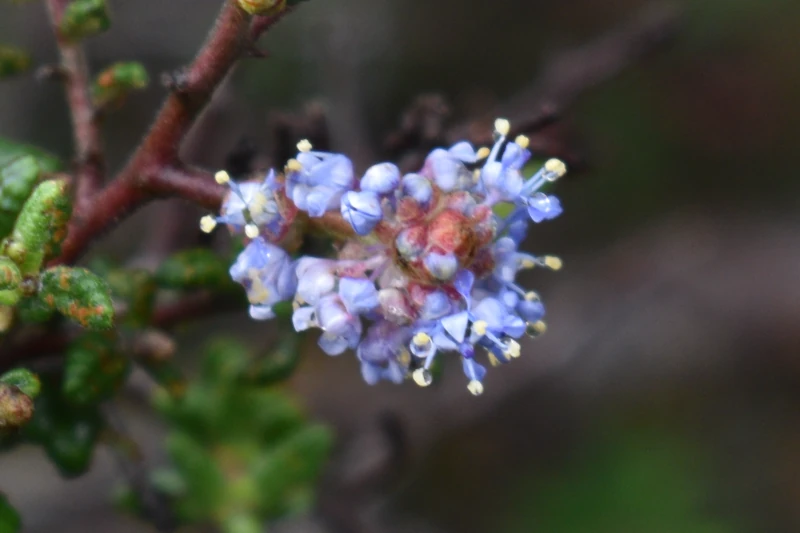
Five blue petals bend together to almost make a sphere and they nearly enclose the flower, leaving five small cracks. A blue stamen topped by a white anther often pops through the crack. One or two blue sepals seem to be be visible in my photo. They are defintely not as prominent as the Lompoc variety's flower. These flowers form in dense clusters.


Habit:
Santa Barbara Ceanothus is an evergreen shrub of our maritime chapparal, sharing the role with Lompoc Ceanothus. larger than its partner chamise, but smaller than manzanita. These three shrubs compete for growing room after a wildfire. Ceanothus seeds require fire to germinate, so mature specimens fade over thirty years, and larger manzanita wins the race until the next fire. This ceanothus grows as a large rounded bush to heights up to 8 feet on Burton Mesa.
The oval leaves may reach 3/4 inches long. Their shiny, dark green surface has deep ribs and wrinkles greatly, forming a convex cup. They attach singly and alternate along reddish brown twigs. Santa Barbara Ceanothus has been the origin for several commercial ceanothus hybrids (Dark Star and Julia Phelps among them) popular with gardeners.
Western Santa Barbara county hosts two native ceanothus: Santa Barbara and Lompoc varieties. The Lompoc subspecies has much paler flowers than other 'mountain lilacs', and leaves in bunches. I found a note in my Mom's desk with her handwriting: "Ceanothus: Santa Barbara—blue, Lompoc—white". Although their ranges coincide and mostly overlap, they do not seem to share areas in BMER's maritime chaparral. Hwy 1 roughly divides the territories of these ceanothus: darker Santa Barbara to the west and paler Lompoc to the east. But I found this specimen in La Purisima State Historical Park, east of BMER.